
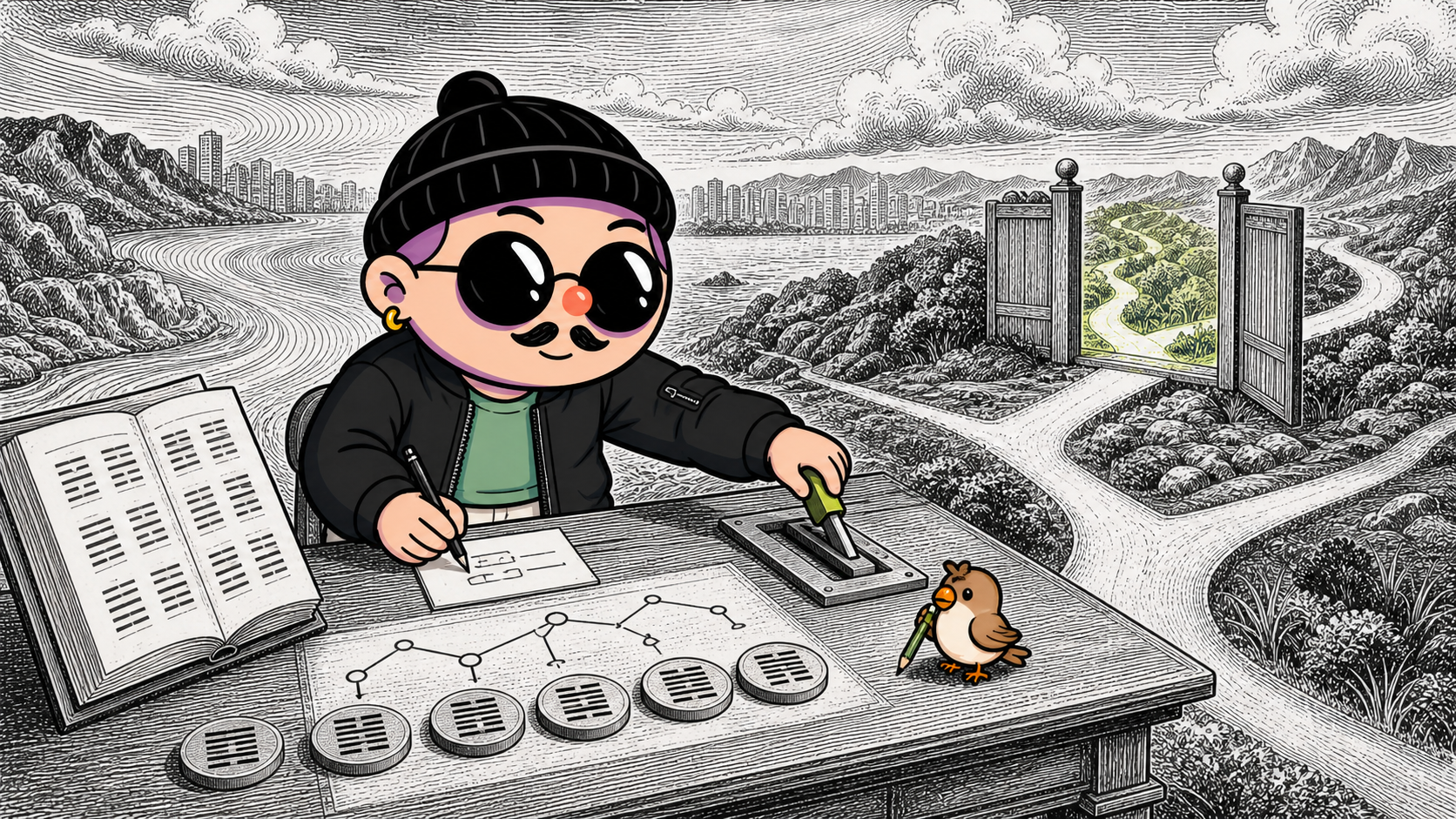
Ask one question with a real context
Vague questions produce vague mirrors.
Name the situation, the decision, and the time horizon if one matters. “What should I understand about accepting this role?” is more useful than “What will happen to my career?”
You are reading one scene, not asking the I Ching to summarize your entire life.
Keep thisOne question. One situation. One reading.
Read the present before the future
Look up the original hexagram and describe it in your own words.
Start with the basic meaning. Name the lower trigram, the upper trigram, and the way their movements meet.
Write one sentence: “This looks like a situation where…” If that sentence does not match the facts, slow down and check the question before adding more layers.
Keep thisIf you cannot describe the present plainly, do not predict the trend.
Find the active change
Locate the moving line, then read its stage and comparable scene.
Is the change just beginning, finding its footing, crossing a threshold, holding the center, or reaching an extreme?
Look up the line statement. Ask what its pressure, timing, or relationship shares with your situation. The old scene is a reference, not an order.
Keep thisPosition first. Line text second. Comparison third.
Check the process and trend
Use only the extra views that answer a real question.
The nuclear hexagram can clarify the process inside the scene. The changed hexagram can show where the current movement tends. Reversed and opposite views can test perspective and contrast.
You do not need to force every layer into every reading. Clarity is the goal, not the number of symbols you can mention.
Keep thisMore layers are useful only when they make the same scene clearer.
Write one usable conclusion
End in ordinary language.
A basic reading can finish in four lines: What is happening now? Which part is moving? Where does that movement tend? What remains yours to decide?
That is enough for a first reading. When you want to measure support, resistance, timing, strength, and more detailed relationships, continue to Master Road.
- This situation is…
- The active change is…
- If it continues, the trend is…
- What I can decide now is…
Keep thisClear enough to use. Open enough to keep your agency.
Choose where to act
The visible trend is one path—not the only path available.
Most readings stop at the changed hexagram and treat it as the answer. That leaves out the most important part: the changed hexagram only shows where the movement already underway tends to lead.
Suppose the top line of Qian moves. If the other conditions stay the same, the structure becomes Lake over Heaven—Breakthrough. That is the direction created by the active line.
But your action can change another part of the field. To turn Qian toward Mountain over Heaven—Great Taming, lines 4 and 5 must both change. In practical terms, you would work at the threshold and the center: change how force enters the outer situation, then change how it is coordinated and restrained.
The same raw drive no longer has to force a breakthrough. It can be contained, accumulated, and prepared for a different use. Decide what kind of development you want, find the part of the situation that can produce it, and act there.
Here is the part almost no one tells you: the changed hexagram shows what happens if the rest of the field stays as it is—not the only future available. Guanxiang breaks that constraint by taking the structure all the way back to first principles. Once you can see how each line reshapes the whole, you can see where your own action can redirect it.
Keep thisThe I Ching shows the active coordinates. You decide where to intervene.
- Ask one real question.
- Read the original field.
- Find the moving position.
- Check process and trend.
- Write one plain conclusion.
- Choose where to act.